The local adaptation of animal body color is crucial in species formation and adaptive evolution, but there is a lack of research on the proximate (physiological and biochemical) and distant (evolutionary) causes of their local adaptation. Du Weiguo's team and Liu Feng's team from the Institute of Zoology of the Chinese Academy of Sciences jointly tackled key problems, took the species of the Guide sand lizard distributed on the Qinghai Tibet Plateau as the research system, integrated indoor and outdoor ecological experiments, genome sequencing, genetic verification and other means, and revealed the driving force of the local adaptation of the body color of the Guide sand lizard, as well as its physiological, biochemical and molecular mechanisms. On January 19th, the related research results were published online in Molecular Biology and Evolution under the title Genetically encoded lamp color diversity for camouflage and thermoregulation.
This study found significant differences in surface spectral reflectance between the warm sand dunes and cold meadows of Qinghai Lake: the light colored Guide sand lizard in the warm sand dune population has a higher spectral reflectance, while the dark colored Guide sand lizard in the cold grassland population has a lower reflectance. Through experiments on the probability of predation in the wild, outdoor activity temperature, and indoor body color temperature regulation, it was found that the body colors of both dark and light colored lizards can effectively act as protective colors in their respective environments and help regulate body temperature. That is, dark body colors are conducive to rapidly increasing body temperature in cold environments, while light body colors effectively prevent excessive body temperature in warm environments.
Physiological and biochemical analysis shows that the difference in body color reflected by the reflectivity of the body surface is caused by the difference in melanin content on the body surface. Through genome resequencing analysis of dark and light populations, a new GC mutation was found at the 459 # locus of the melanogenesis related gene Tyrp1 in the dark lizard population, which is the genetic basis for body color differentiation. The results showed that the allele frequency of this locus was 22.22% G/C and 77.78% C/C in dark lizards, and 100% G/G in light lizards. The study predicted the enzyme tertiary structure and catalytic activity of TYRP1 through a model and found that this mutation increased the flexibility and catalytic activity of TYRP1 enzyme structure, promoting the generation of melanin on the surface of dark lizards.
Furthermore, the study found that in the functional verification experiment of Tyrp1 gene using zebrafish system, zebrafish injected with the dark lizard Tyrp1 genotype detected more melanin content and deeper body color, verifying the function of Tyrp1 mutation in melanogenesis. Researchers used wild-type zebrafish as the research system and injected plasmids containing the gene sequences of light lizard Tyrp1 (Tyrp11376G) and dark lizard Tyrp1 (Tyrp11376C). They found that after injection, the individual's body color became darker than the wild-type, while zebrafish injected with the dark lizard Tyrp1 gene had the darkest body color. The darkening of zebrafish body caused by injection of the dark lizard Tyrp1 plasmid is not achieved by increasing the number of melanocytes, but by increasing the melanin content within melanocytes.
In short, through systematic experimental research and data analysis, this study discovered that new mutations from key genes involved in melanogenesis constitute the genetic basis for surface color variation in the Guide Sand Lizard, as well as the joint selection or enhanced adaptive genetic differentiation of body color by protective color and temperature regulation, enabling adjacent populations with different body colors to survive.
The research work was supported by the second comprehensive scientific investigation and research on the Qinghai Tibet Plateau, the Chinese Academy of Sciences strategic leading science and technology project, the joint project of Sanjiangyuan National Park and Chinese Academy of Sciences, the national key research and development plan, the National Natural Science Foundation of China and the Chinese Academy of Sciences Youth Innovation Promotion Association.
Paper link
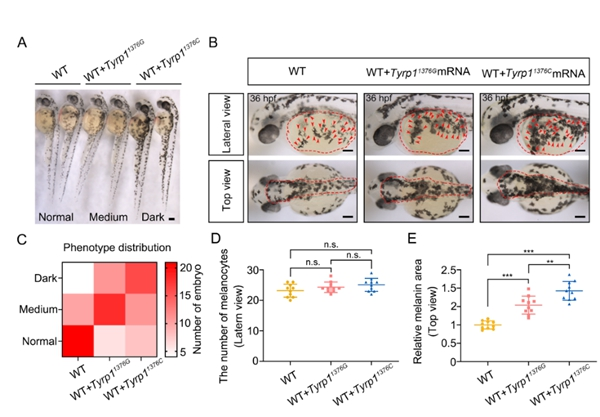
Functional verification experiment of zebrafish reveals the function of Tyrp1 gene in dark populations